
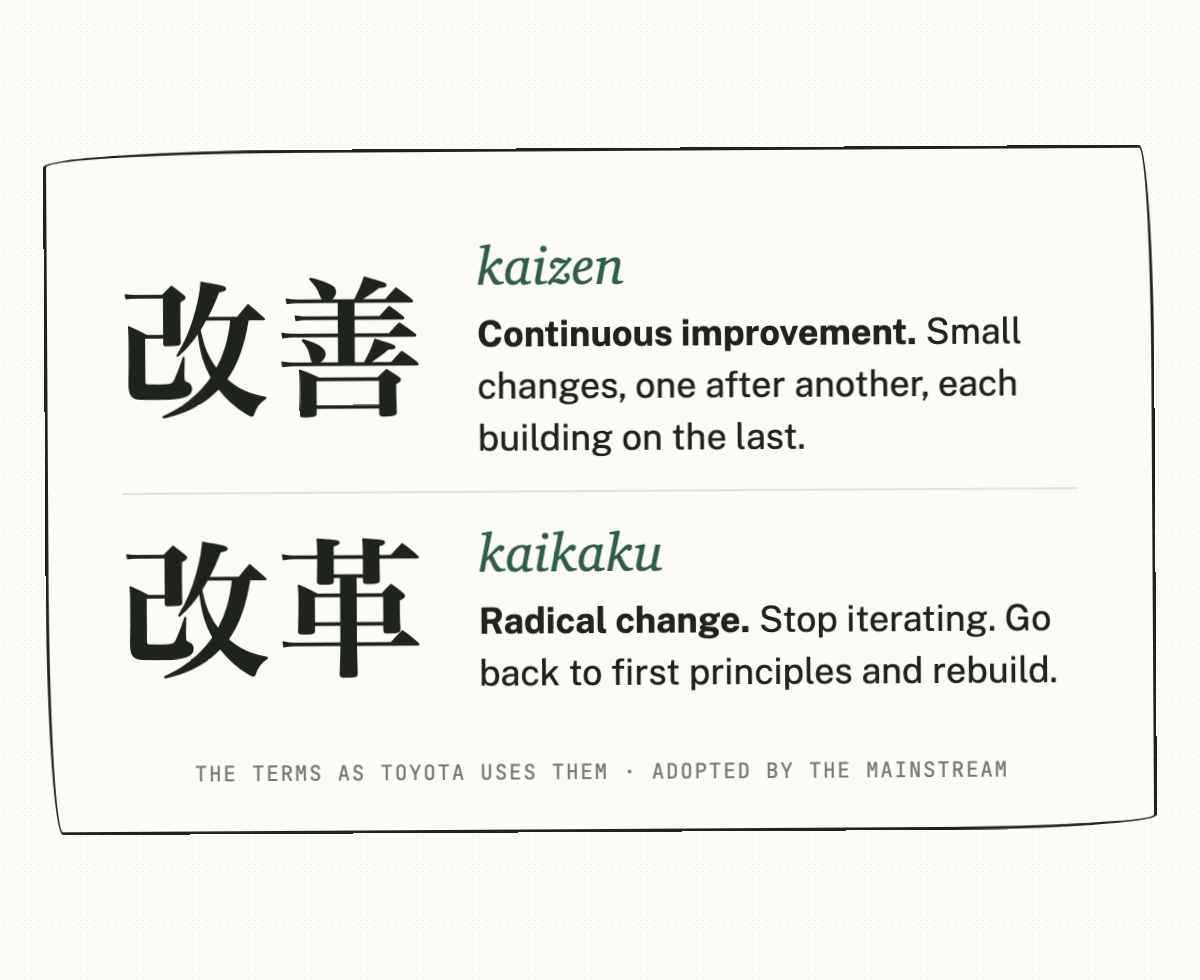
Kaizen or Kaikaku?
Starting over used to cost so much that nobody could justify it. AI changed the price of finding out whether you should.
You're at base camp right before a summit push when the weather turns and you find yourself unprepared for the conditions. You think back to the difficult, convoluted route you took to get here, lugging the wrong equipment the whole way. You're faced with a hard choice: trudge the rest of the way up and see if you can figure it out as you go, or scrub the summit and come back another day, better equipped.
Maybe you've never gone near Everest, but this still may sound familiar. You've hit this fork at school, at work, and on personal projects. You're a month in and it isn't turning out the way you planned. Do you keep trying to figure it out with incremental changes, or go back to base principles?
Nobody who just made it to base camp would easily be convinced to forfeit their progress and start over. The time and effort cost of starting over is steep, and worse, it's difficult to understand the full price until you're already paying it. But what if it wasn't? What if a helicopter picked you up at base camp, flew you back down, and set you at the trailhead knowing exactly what to pack this time?
Hold that thought. First let me tell you about a time before the helicopter existed.
I've always been on the kaikaku side of the fence, and it has cost me. About five years ago I was months into building a new platform when I realized that if my team kept to the agreed-upon plan, it would ship with real problems for anyone trying to adopt it.
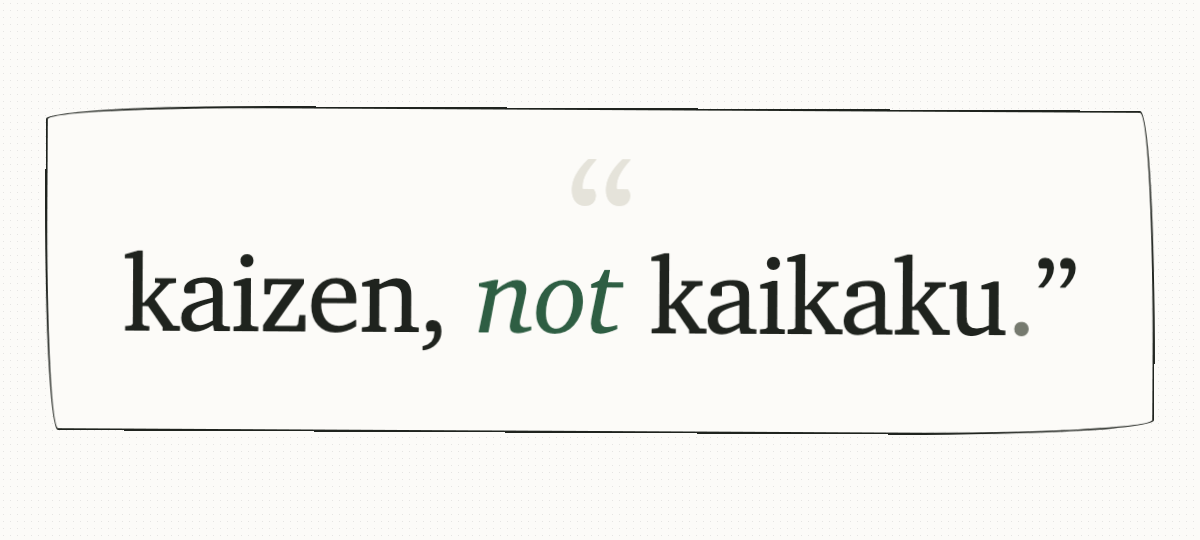
So I went back to the whiteboard and started fresh. It launched, it worked, however it was late. The delay became the story, not the platform. The phrase used to describe where I fell short and what I should have done: "kaizen, not kaikaku."
The rewrite was expensive, even though it was the right call. Imagine the cost if I'd been wrong. The kicker was that I couldn't know I was right until the rewrite was done. The evidence I needed to justify starting over only existed on the far side of starting over.
So why not just keep going?
I'm not arguing that kaikaku is always the right path. Kaizen is vital. Without it, kaikaku wouldn't be possible.
The months of iterating taught me what the platform actually needed. The second attempt worked because the first one had already paid for the answers: which abstractions held up and which flows didn't. It wasn't until we started executing the plan that we realized reality disagreed. The best path was earned through kaizen.
Why even start from scratch? Kaikaku is essential because even if every iteration was the correct move, the cracks form under the weight of the sum of them. Each iteration carries a little debt forward. The shortcuts you promised yourself you'd clean up later and the stubs you left behind build into black ice under everything that comes after. Starting over gives you a fresh foundation built from what kaizen taught you, without the cruft.
Where does AI come in?
AI is the helicopter. It collapses the stretch between deciding to start over and being ready to start, so you can focus on weighing the benefits of a restart instead of flinching at the effort of evaluating one.
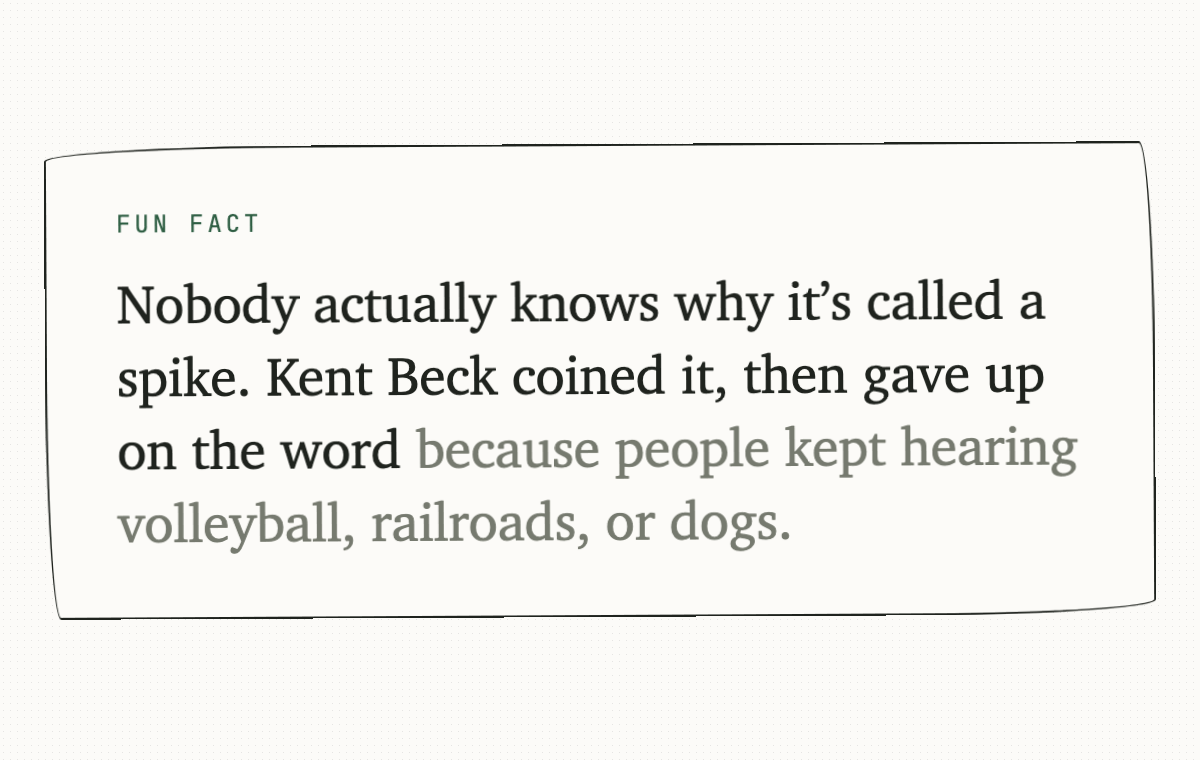
There is a pattern that already exists for quickly determining the feasibility of a path: a spike.
A spike is a short, time-boxed, deliberately disposable attempt at something to determine if an idea holds water before you commit real effort to it.
The problem is that spikes were built for small, forward-looking questions. Spikes typically don't answer "should I start over", they answer "should I proceed". Using a spike for kaikaku means taking stock of everything behind you: what carries over, what gets left behind, and which mistakes must not be repeated. That audit can take more time and effort than the rewrite itself, which leads most people to never do it. They just keep climbing.
This is the gap AI closes. Point it at the thing you're thinking about abandoning and have it answer three questions. What still earns its place? What am I dragging along out of habit? What did I learn the hard way that the next version must be built around?
An afternoon later you have a draft answer for each, grounded in your actual work rather than your memory of it. What used to take weeks of archaeology to even frame the restart decision can now be unearthed before your resolve wears out.
AI surfaces more evidence, faster. However, it does not buy certainty. The cheap, quick evidence can cut both ways. It can send you down the right path, and just as expeditiously and confidently, down the wrong one.
This risk can be mitigated by staying in the loop. After AI charts a route, make sure you read and understand it, and make adjustments if required. AI is the navigator, not the driver. Stay vigilant at the wheel.
Kaizen, then kaikaku.
It isn't a question of "or". It's a question of sequence. The iteration earns the rewrite, and the rewrite is what the iteration was for. Don't get locked into the kaizen trap because it feels overwhelming to start over. AI changes the time and effort cost of knowing whether it's worth the restart or to continue to inch forward, so there's no reason to feel like one foot in front of the other is your only option.
Kaizen, then kaikaku.